AI Website Generator for Booking and Ecommerce

See how an AI website builder can launch a business site with online booking, ecommerce, and SEO-ready pages already built in — not bolted on after the fact.

Most small businesses that need a website also need two things a plain brochure site doesn't give them: a way for customers to book an appointment, and a way to sell something online. The usual path is to build the site first, then bolt on a booking app, then bolt on a store app, then spend a weekend making sure all three actually talk to each other. An AI website builder that generates booking and ecommerce as part of the site — not as separate installs — skips that whole process.
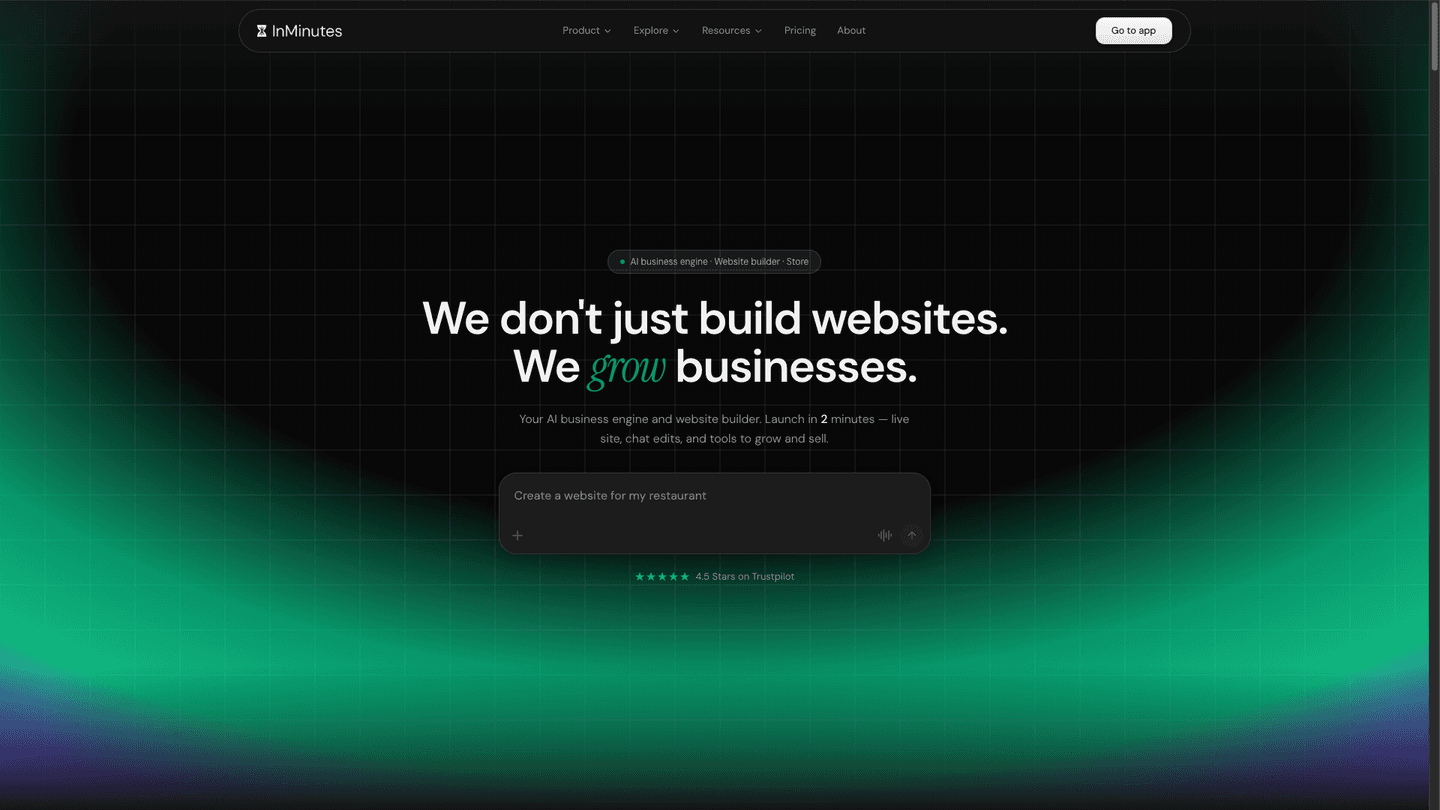
Quick answer: if you need a business website with online booking and an online store, look for an AI website generator that builds both into the site at creation time, not one that hands you a page and expects you to add apps afterward. InMinutes does this by generating the site, the booking flow, and the store together from your real business data, live in under two minutes.
What "AI website generator" actually means here
Not every tool that calls itself an AI website builder does the same job. Some use AI to speed up a questionnaire, then still hand you a blank template to fill in yourself. Others — InMinutes among them — use AI to generate the finished site directly from real business data: your name, address, hours, category, and reviews, pulled from your Google Business listing. The difference matters most once booking and ecommerce enter the picture, because those aren't just extra pages — they're systems that need to work correctly from day one.
Online booking integration
For a salon, clinic, contractor, or any appointment-based business, booking is the feature that actually drives revenue — a beautiful homepage with no way to book is a business card, not a website.
Most builders treat booking as an add-on: install a separate scheduling app, connect it to your calendar, map it to your services, then embed it somewhere on the site. Each of those steps is a place to get something wrong, and it's still one more login to manage.
InMinutes generates the booking flow as part of the site itself. Your services, hours, and availability come from the same business data used to build the rest of the site, so there's no second system to configure — a customer can book the moment the site goes live. Changes ("add a $20 deposit for new clients," "block off Sundays") are made by describing them in chat rather than digging through a separate app's settings.
Ecommerce features
The same logic applies to selling online. A lot of website builders support ecommerce, but "support" often means a percentage-based transaction fee on top of your subscription, plus a separate setup flow for products, shipping, and checkout.
An AI website generator built for small businesses should treat the store as a default feature, not an upsell. InMinutes includes a built-in store on the Pro plan with 0% platform transaction fees — products, cart, and checkout are generated alongside the rest of the site, so a bakery, boutique, or service business with add-on products can start selling without installing anything extra.
Business website creation
The fastest way to describe the difference: template builders start from a blank canvas and ask you to fill it in; InMinutes starts from your actual business and generates the site around it. Type your business name and city, and the AI pulls your real hours, address, phone number, category, and reviews, then writes copy and builds layout, booking, and store specifically for that business — not generic placeholder text you'll spend hours rewriting.
That matters more than it sounds like it should. A restaurant, a dental clinic, and a contractor don't need the same layout, the same emphasis, or the same tone — and generating from real data means the AI can actually make those calls correctly the first time.
SEO tools for websites
A site with booking and a store is only useful if people can find it. Instead of treating SEO as a separate checklist to work through after launch, InMinutes builds meta tags, structured data (Schema.org), fast-loading clean HTML, and AI-search foundations (GEO/AEO — things like llms.txt and FAQ structured data) into every generated site by default. That last part matters increasingly in 2026, as more customers find local businesses through AI-powered answers rather than a traditional search results page.
Website builder comparison
AI-native generator (InMinutes) | Traditional builder + apps | |
|---|---|---|
Time to live site | Under 2 minutes | Hours, often a full weekend |
Booking | Built in at generation | Separate app, manual setup |
Ecommerce | Built in, 0% transaction fees | Separate app, percentage fees |
Copy | Written from your real business data | Placeholder text you rewrite |
SEO / AI-search | On by default | Manual setup, often skipped |
Editing | Chat-to-edit | Drag-and-drop, manual |
Small business website design
Design quality still matters even when generation is fast. InMinutes tailors layout to business category at creation time — a restaurant gets a food-first design with menu and hours front and center, a clinic gets a trust-and-credentials-first layout, a contractor gets a portfolio-first design built around past work. That's a meaningfully different approach from a generic template you customize yourself, and it's what makes a two-minute generated site look considered rather than default.
FAQ
The bottom line
Booking and ecommerce shouldn't be things you bolt onto a website after the fact — they should be part of what "website" means for a business that needs them. An AI website generator that builds both in from the start, along with SEO and AI-search foundations, turns website setup from a multi-app project into a single step. Build your site free with InMinutes →

Guides15 min read

Guides9 min read
Guides14 min read
Guides10 min read